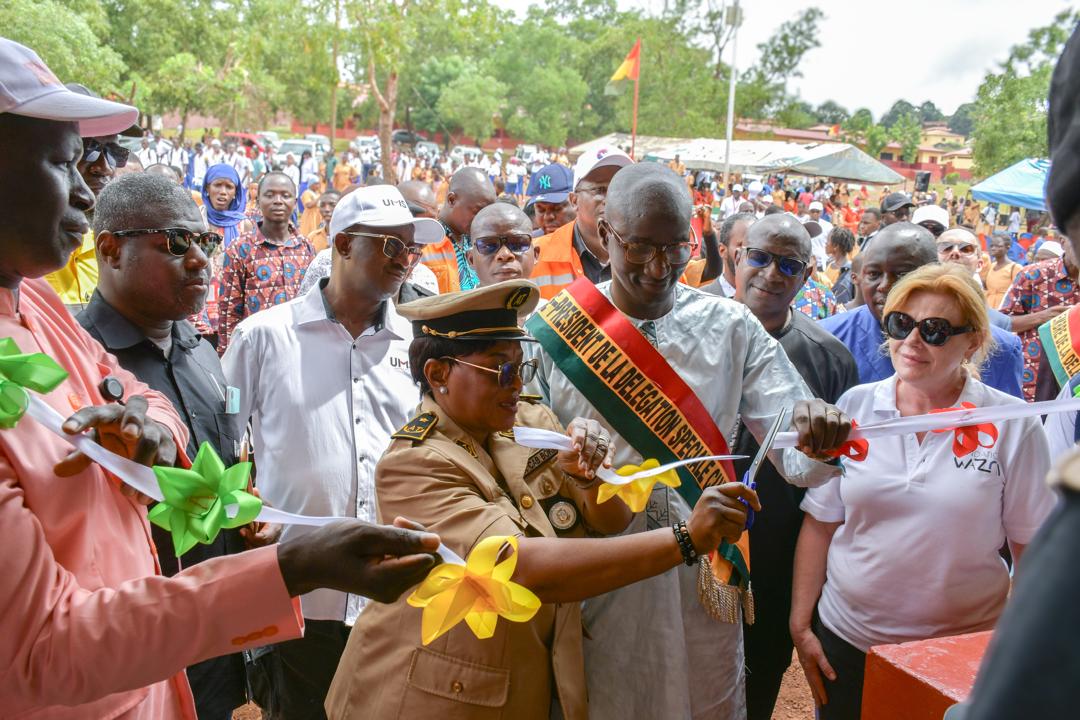
The UMS Group and the Wazni Foundation inaugurate their 12th renovated school, the Filira College-Lycée, a symbol of a lasting commitment to education in Boké.
Boké, October 31, 2024 – The Wazni Foundation and the UMS Group celebrate the official inauguration of the Filira Middle School, their 12th renovated school in the Boké region. Thanks to this ambitious program, more than 8,680 students are benefiting from the renovation of school infrastructure, providing suitable and safe learning environments for the region’s youth. This renovation is part of the ongoing renovation efforts led by the Wazni Foundation and the UMS Group, aimed at improving access to education and creating optimal learning conditions for younger generations.
Filira Middle School, founded in 1960, is a historic institution that now welcomes 1,680 students in a modernized learning environment. This number includes 1,226 middle school students, including 560 girls, and 454 high school students, including 195 girls. The teaching staff is composed of 25 middle school teachers, including one woman, and 21 high school teachers, also including a woman. The administration has five members at the middle school, including one woman, and three men at the high school.
After many years of deterioration, the school underwent a complete renovation from May to October 2024. The work enabled the renovation of 28 classrooms, including 17 for the middle school and 11 for the high school, which are now clean, safe, and suitable. In addition, 20 latrines, a drinking water supply system installed through a borehole, a health center, and a library were renovated, along with the construction of a shelter for the canteen workers. The Wazni Foundation and the UMS Group are thus providing the young people of Boké with an environment conducive to their education and an improved working environment for teachers.
In partnership with the local company Molade, which employs more than 20 people, 50% of whom are women, the renovations not only restored the infrastructure but also helped boost the local economy. This initiative included the manufacture of 420 tables and benches by local artisans, thus strengthening the local economy and creating a virtuous circle of development. Filira Middle School is now included in the annual maintenance and ongoing awareness-raising program, aimed at ensuring the sustainability of the infrastructure.
Mady Dabo, Principal of Filira Middle School, said, “I feel immense pride in seeing the Filira complex renovated. Thanks to the Wazni Foundation and the UMS Group, our students have the means to achieve their potential in much more favorable conditions. On behalf of the students, parents, and teaching staff, we sincerely thank them.”
Hadja Gnalen Condé, Chief of Staff of the Boké Governorate, emphasized: “Education is a fundamental pillar of sustainable development in our region. By renovating the Filira College-Lycée, the Wazni Foundation and the UMS Group are demonstrating their commitment to preparing our young people for a better future. This investment in educational infrastructure goes beyond the walls; it is about empowering our young people to build the Guinea of tomorrow, by placing them at the heart of our regional development strategy.”
Fadi Wazni, President of the Wazni Foundation, added: “I feel a deep joy to see the Filira College-Lycée reborn, a place that holds a special place in my heart and that of the Boké region. By carrying out this essential work, we renew our sincere commitment to the education of our young people. Each renovated school is one more step towards a better future for the children of Boké. With the UMS Group and the Wazni Foundation, I am honored to support these young people who will carry the Guinea of tomorrow.”
The Wazni Foundation and the UMS Group reiterate their commitment to contributing to education and sustainable development in the Boké region. This project is part of a comprehensive vision aimed at improving the living conditions of younger generations by integrating education, health, and local employment, and by favoring an inclusive and participatory approach.